What Is a Framing Nailer Used For?
A framing nailer is a power tool that drives large nails into construction lumber for jobs such as wall framing, subfloors, roof decking, and fencing. Choose one only after matching its fasteners to your project.
On this page (7 sections)
- What is a framing nailer used for?
- How do you choose the right framing nailer?
- Which pneumatic framing nailer suits your work?
- When should you choose a cordless framing nailer?
- How do you set up a framing nailer safely?
- Which mistakes and care habits matter most?
- What is a framing nailer worth buying for?
A framing nailer is a power tool that drives large nails into construction lumber for wall frames, subfloors, roof decking, and similar work. If you're asking what is a framing nailer, think of repeated wood connections rather than small trim repairs.
It feeds collated nails from a magazine, so you don't position each nail by hand. Start with the fasteners your project requires, then choose a tool that accepts them.
What is a framing nailer used for?
A framing nailer fastens substantial wood assemblies, including framing members and panels attached to framing. Its main benefit is making repeated connections without swinging a hammer for every nail.
Common jobs include:
- Assembling wall frames
- Fastening subfloor panels
- Attaching roof decking and wall sheathing
- Truss and window build-up
- Building wood fences
- Assembling pallets and shipping crates
The tool doesn't decide how strong a connection will be. Nail size, placement, spacing, wood condition, and the connection design still matter.
For a broader view of which tool belongs on each project, see our complete guide to nail guns.
Is a framing nailer right for a deck or fence?
A framing nailer can help with wood framing and fencing when the specified nails fit the tool. It isn't a substitute for every screw, bolt, or connector required by a deck plan.
Use fasteners suited to outdoor exposure and compatible with treated lumber where applicable. Metal connectors may need dedicated connector nails and an approved tool, so don't assume ordinary framing nails will work.
When is a framing nailer unnecessary?
A framing nailer is unnecessary when a hammer can handle the few required nails or the job calls for smaller fasteners. A single loose board rarely justifies setting up an air system.
It's also too large for delicate molding and many narrow trim pieces. Compare what a finish nailer is used for and what a brad nailer is used for before choosing a tool for finish work.
How do you choose the right framing nailer?
Choose by fastener compatibility first, then power source and access. A convenient nailer is the wrong tool if it can't drive the nails your plans require.
Check these details before buying:
- Length and diameter: Both must fall within the tool's accepted range.
- Collation: The nail strip's angle and joining material must match the magazine.
- Head style: Full round, offset round, and clipped heads aren't automatically interchangeable.
- Project requirements: Follow the plans and applicable building requirements for fastener type and spacing.
- Access: Consider corners, stud bays, and the space needed to position the nose.
A magazine angle describes the nail strip's arrangement, not the angle at which you must drive every nail. A steeper magazine can help with access, but it doesn't replace correct positioning.
What is a framing nailer's depth adjustment for?
A framing nailer's depth adjustment controls how far the nail head enters the wood. Set it for the connection rather than assuming deeper is stronger.
Overdriving can damage the surface, especially on sheathing. Check the required head position on matching scrap before fastening the actual assembly, and recheck when changing materials.
Which pneumatic framing nailer suits your work?
Choose a pneumatic model if you can supply the required compressed air and manage a hose. These 3 options suit different nail supplies and working conditions.
Metabo HPT NR90AES1: for general framing with plastic-collated nails
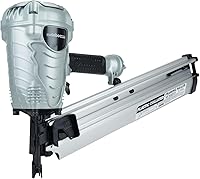
The NR90AES1 suits buyers who want a 21-degree air nailer for framing, flooring, and sheathing. It accepts plastic-collated nails from 2 in to 3 1/2 in and weighs 7.5 lb.
Its tool-less depth adjustment helps when moving between materials. A selector switches between sequential and contact firing, though sequential operation is the better starting point for controlled placement.
Choose it when that nail format matches your project and you already have suitable air equipment. Skip it if you need paper-collated nails or want to work without a hose.
Our Metabo HPT NR90AES1 review takes a closer look at its features and fit.
Metabo HPT NR90ADS1: for framing in tight corners
The NR90ADS1 suits buyers who need a magazine designed for access in tight corners. It uses 30-degree paper-collated clipped-head and offset round-head nails from 2 in to 3 1/2 in.
It weighs 7 lb and includes selective actuation and tool-less depth adjustment. Metabo HPT backs it with a 5-year warranty.
Choose it if your required nails come in that compatible format. Skip it if your existing nail supply is 21-degree plastic collation, and confirm that the chosen head style meets your project's requirements.
NuMax SFR2190: for fencing and mixed wood projects
The NuMax SFR2190 suits buyers doing wood fencing, framing, pallets, or crates with an air setup. It takes 21-degree plastic-collated full round-head nails, 2 in to 3 1/2 in long and 0.113 in to 0.131 in in diameter.
Its anti-dry-fire mechanism prevents empty firing. Tool-free depth adjustment, a no-mar tip, and adjustable exhaust help you set the tool for the work surface and direct exhaust away from your face.
At 8.6 lb, it deserves careful consideration if you'll hold the tool up repeatedly. Choose it for its project range and features; skip it if lower tool weight is your main priority.
When should you choose a cordless framing nailer?
Choose cordless power when moving freely matters more than keeping tool weight down. It can make sense for scattered repairs or work where routing a hose would slow you down.
The Craftsman CMCN621PL V20 uses 21-degree plastic-collated full round-head nails up to 3 1/4 in. It needs no compressor, hose, or gas cartridge, and its battery and charger are sold separately.
This model suits buyers who already use compatible V20 equipment or want a hose-free setup. Craftsman says it can drive its maximum-length nails into laminated veneer lumber.
Skip it if your plans require 3 1/2 in nails. Its 10.75 lb weight also matters for repeated lifting, and tool-free depth adjustment won't overcome an incompatible fastener requirement.
Compare the workflow in cordless versus pneumatic nailers, or see best cordless framing nailers if mobility is your deciding factor.
How do you set up a framing nailer safely?
Start with the manual, correct nails, and a secure workpiece. Wear eye and hearing protection, keep others clear, and identify what is behind the fastening point.
For a pneumatic tool, confirm that the compressor, hose, and fittings meet the manual's requirements. Set regulated pressure within the allowed range rather than increasing it until every nail disappears below the surface.
For cordless equipment, use a compatible battery and follow the charging instructions. Follow the manual's exact loading and power-connection order for either type.
Select sequential firing when available for controlled placement. On matching scrap, check nail depth and placement before starting the assembly.
Keep your free hand away from the nail path and the opposite side of the wood. Nails can pass through or deflect, especially near edges, knots, or existing fasteners.
Read how to use a nail gun safely before operating one. The NIOSH nail gun safety guide explains trigger choices and injury prevention.
Which mistakes and care habits matter most?
Avoid wrong nails, excessive depth, and rushed placement. These cause problems that a more powerful tool won't solve.
Don't force a mismatched strip into the magazine or assume all nails of the same length fit. Keep nail packaging until you've confirmed the angle, diameter, head style, and collation.
Don't fire near an edge without checking the required spacing. Reposition the work or change the fastening method when the connection leaves too little room.
Disconnect the air supply or remove the battery before clearing jams, servicing, or making adjustments as directed by the manual. Never bypass the contact safety mechanism.
Keep the magazine and nose free of debris, inspect hoses or batteries for damage, and store nails dry. Oil a pneumatic tool only as its manual directs, using the specified lubricant and amount.
What is a framing nailer worth buying for?
A framing nailer is worth buying for repeated lumber fastening with a clear fastener plan. For a small repair, use the required nails and a hammer rather than buying a system you rarely need.
Choose the NR90AES1 for compatible plastic-collated framing work, the NR90ADS1 for paper-collated nails and corner access, or the NuMax for its fencing and mixed-project features. Choose the Craftsman when hose-free movement matters and its nail capacity meets the job.
With the project and nail requirements settled, use our framing nailer guide to narrow your requirements and best framing nailers to compare suitable tools.
Frequently asked questions
What is a framing nailer used for?
A framing nailer drives large nails into construction lumber for wall frames, subfloors, roof decking, sheathing, and other substantial wood assemblies; it helps with repeated fastening, but the tool must accept the exact fasteners your project requires. Nail length alone isn't enough; check diameter, head style, collation, and outdoor suitability too.
Can a framing nailer be used for trim?
A framing nailer is usually too large for trim because its heavy nails can split narrow boards and leave large holes. Use a finish nailer for suitable trim joints or a brad nailer for lighter pieces; choose the fastener for the material and connection rather than using whichever nailer is available.
What is the difference between a framing nailer and a finish nailer?
A framing nailer drives larger nails for construction lumber, while a finish nailer uses smaller nails for trim and finish work; they serve different joints and aren't interchangeable just because both drive nails. Our guide to what a finish nailer is used for explains where the smaller tool fits.
Do framing nailers need an air compressor?
Pneumatic framing nailers need an air compressor and hose, while battery-powered models work without that air connection. Match a compressor's pressure and air delivery to the tool manual, or confirm battery compatibility for a cordless model; check what comes with the tool before budgeting for the rest of the setup.