8 Best Framing Nailers (October 2026)
The best framing nailers include the Metabo HPT NR90AES1 21 Degree Framing Nailer for all-around framing, the Metabo HPT NR90ADS1 30 Degree Framing Nailer for tight corners, and the NuMax SFR2190 21 Degree Framing Nailer for mixed outdoor projects.
On this page (11 sections)
- How we chose the best framing nailer
- The best framing nailers for different jobs
- Which fasteners must your framing nailer accept?
- Is a pneumatic or cordless framing nailer better?
- Which controls make framing work easier?
- How should you set up a framing nailer?
- What mistakes should you avoid with a framing nailer?
- How do you care for a framing nailer?
- How can you use a framing nailer safely?
- Frequently asked questions
- Which framing nailer should you choose?
The best framing nailer for most buyers here is the Metabo HPT NR90AES1, provided you have a suitable compressor and use compatible nails. Choose the NR90ADS1 for tight corners and paper collated fasteners, or a Metabo HPT cordless kit for repairs spread across several work areas.
Start with the connection you need to build, then choose the nailer. Required nail size, head shape and coating matter more than a convenient battery platform or a long feature list.
Our guide to what a framing nailer is used for explains suitable projects. For a wider view of tool types, see nail guns for home projects.
Our picks at a glance
-
1
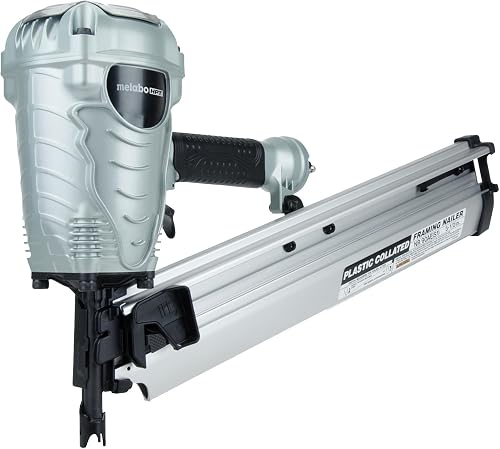 Best for all-around framing
Metabo HPT NR90AES1 21 Degree Framing Nailer
9.1/10 our score
See it on Amazon -
2
 Best for tight corners
Metabo HPT NR90ADS1 30 Degree Framing Nailer
8.4/10 our score
See it on Amazon -
3
 Best for mixed outdoor projects
NuMax SFR2190 21 Degree Framing Nailer
8.0/10 our score
See it on Amazon
- 4
 Check it
Metabo HPT NR1890DRA 18V Framing Nailer Kit
Best for scattered framing repairs - 5
 Check it
Metabo HPT NR1890DCA 18V 30 Degree Framing Nailer Kit
Best for mobile corner work - 6
 Check it
Craftsman CMCN621PL V20 Cordless Framing Nailer
Best for existing V20 users - 7
 Check it
3PLUS H2190SP 21 Degree Framing Nailer
Best for supported bench work - 8
 Check it
DOTOOL 21 Degree Framing Nailer
Best for deliberate nail placement
How we chose the best framing nailer
Fastener compatibility, handling and power setup determined which buyers each nailer suits. We compared supported nail formats, tool weights, firing controls, depth adjustments and kit contents.
A lighter air tool makes sense when your compressor can stay near a long work session. A cordless kit earns its place when carrying and routing an air setup would add repeated work.
GracefulGate's scores reflect those features and their fit for framing tasks. We give clear limits alongside each recommendation so you can choose around your actual job.
| Product | Best for | Angle and collation | Nail length | Power | Our score |
|---|---|---|---|---|---|
| Metabo HPT NR90AES1 21 Degree Framing Nailer | all-around framing | 21° plastic collated | 2–3-1/2 in | Pneumatic | 9.1 |
| Metabo HPT NR90ADS1 30 Degree Framing Nailer | tight corners | 30° paper collated | 2–3-1/2 in | Pneumatic | 8.4 |
| NuMax SFR2190 21 Degree Framing Nailer | mixed outdoor projects | 21° plastic collated | 2–3-1/2 in | Pneumatic | 8.0 |
| Metabo HPT NR1890DRA 18V Framing Nailer Kit | scattered framing repairs | 21° plastic strip | Up to 3-1/2 in | 18V battery | 7.6 |
| Metabo HPT NR1890DCA 18V 30 Degree Framing Nailer Kit | mobile corner work | 30° paper tape collated | 2–3-1/2 in | 18V battery | 7.4 |
| Craftsman CMCN621PL V20 Cordless Framing Nailer | existing V20 users | 21° plastic collated | Up to 3-1/4 in | V20 battery | 7.3 |
| 3PLUS H2190SP 21 Degree Framing Nailer | supported bench work | 21° plastic collated | 2–3-1/2 in | Pneumatic | 7.2 |
| DOTOOL 21 Degree Framing Nailer | deliberate nail placement | 21° offset round head | 2–3-1/2 in | Pneumatic | 7.1 |
The best framing nailers for different jobs
Choose the NR90AES1 for general pneumatic work, then move to another pick for a specific need. Magazine access, mobile repairs, an existing battery platform and repeated lifting can all change the choice.
Metabo HPT NR90AES1 21 Degree Framing Nailer
- 21-degree plastic collated
- Drives 2–3-1/2 in nails
- 7.5 lb
- Selective actuation
- Tool-less depth adjustment
Choose this pneumatic model for a mix of framing, subfloor and sheathing work. Its weight and simple depth and firing-mode controls make it the strongest general-purpose choice here.
Pros
- 7.5 lb tool weight
- Selectable sequential or contact nailing
- Tool-less depth adjustment
Cons
- Requires a compressor and hose
- Not compatible with paper collated framing nails
The NR90AES1 is the most sensible starting point for someone building frames, laying subfloors or attaching wall sheathing with an existing air setup. Its 7.5 lb weight makes it a better choice for repeated lifting than the heavier pneumatic options here.
It takes 21-degree plastic collated nails from 2 to 3-1/2 in, with selective actuation and tool-less depth adjustment. Those controls let you choose deliberate placement and tune depth as you move between materials.
Buy it for a mix of construction tasks where you can keep the compressor connected. It avoids adding battery charging to a work area that already has dependable air.
Skip it if you mainly make a few repairs at separate locations or already stock incompatible paper collated nails. Our NR90AES1 review gives this model a closer look.
Metabo HPT NR90ADS1 30 Degree Framing Nailer
- 30-degree paper collated
- Drives 2–3-1/2 in nails
- 7 lb
- Selective actuation
- Tool-less depth adjustment
A good fit for buyers who need a steeper magazine for corner access and use compatible paper collated nails. It is the lightest pneumatic model in this group.
Pros
- Magazine designed for tight corners
- 7 lb tool weight
- Selectable firing modes
Cons
- Requires a compressor and hose
- Does not use 21-degree plastic collated nails
The NR90ADS1 is the stronger choice when corner access and lower tool weight lead your decision. Its 30-degree magazine is designed for tight corners, and the tool weighs 7 lb.
It accepts paper collated clipped and offset round head nails from 2 to 3-1/2 in. Selectable firing modes and tool-less depth adjustment cover the main controls needed when moving between framing connections.
Choose it for an air-powered setup built around compatible paper collated fasteners. Metabo HPT backs it with a 5-year warranty, as it does the NR90AES1.
Skip it if your nail supply is plastic collated or you need hose-free movement. Before buying it for a cramped connection, consider the whole tool's approach angle, since a steeper magazine cannot solve every clearance problem.
NuMax SFR2190 21 Degree Framing Nailer
- 21-degree plastic collated
- Drives 2–3-1/2 in nails
- Dual mode trigger
- Anti-dry-fire mechanism
- 360-degree adjustable exhaust
This pneumatic option suits a workload that includes framing, fencing, pallets and shipping crates. Empty-fire protection and adjustable exhaust add useful controls for varied work.
Pros
- Anti-dry-fire mechanism
- Tool-free depth adjustment
- Exhaust direction adjusts
Cons
- Requires an air supply
- 8.6 lb weight exceeds both pneumatic Metabo HPT picks
The NuMax SFR2190 fits a buyer whose work includes fencing, pallets and shipping crates alongside framing. Its supported applications make it worth considering for a workshop that handles several kinds of rough construction.
It uses 21-degree plastic collated full round head nails from 2 to 3-1/2 in, with diameters from 0.113 to 0.131 in. A dual-mode trigger, anti-dry-fire mechanism and adjustable exhaust provide useful day-to-day controls.
Choose it when empty-fire protection matters and your projects do not involve constant lifting. At 8.6 lb, it asks more of your arm than either pneumatic Metabo HPT pick.
Skip it if low weight is your main goal. For exterior projects, our nail guns for fencing guide helps you match the tool and fasteners to the fence work.
Metabo HPT NR1890DRA 18V Framing Nailer Kit
- 18V cordless
- 21-degree plastic strip
- 4.0Ah battery included
- Metabo HPT claims up to 500 nails per charge
- 8.4 lb without battery
Choose this kit for separate repair spots where moving an air setup adds work. A battery and charger are included, but battery weight adds to the tool's stated weight.
Pros
- No compressor or hose
- Battery and charger included
- Tool-less depth adjustment
Cons
- Battery adds to the 8.4 lb tool weight
- Needs charging between work sessions
The NR1890DRA suits scattered framing repairs where moving a compressor takes a large share of the job. The kit includes a battery and charger, so buyers starting without an air system have fewer separate parts to arrange.
This 18V model uses a 21-degree plastic strip format and drives nails up to 3-1/2 in. Metabo HPT claims up to 500 nails per charge with the included 4.0Ah battery; plan around that as a maximum, not a fixed workday allowance.
Tool-less depth adjustment and selectable firing modes support changes in placement and material. The tool weighs 8.4 lb before the battery, so cordless freedom comes with more carried weight than the pneumatic Metabo HPT options.
Choose it for mobility, especially when the hose route would cross doors or finished rooms. Skip it if your compressor already stays beside a fixed work area and low tool weight matters most.
Metabo HPT NR1890DCA 18V 30 Degree Framing Nailer Kit
- 18V cordless
- 30-degree paper tape collated
- 4.0Ah battery included
- Metabo HPT claims up to 500 nails per charge
- 8.2 lb without battery
This kit suits buyers who need both cordless movement and a paper tape magazine. The aggressive nose is designed to help maintain placement during angle nailing.
Pros
- Battery and charger included
- Selectable firing modes
- No hose to route around framing
Cons
- Battery adds to the 8.2 lb tool weight
- Requires compatible paper tape collated nails
The NR1890DCA fits buyers who need paper tape fasteners and cordless movement together. It is the more direct choice than the cordless plastic strip model when your work already uses that nail format.
Its 30-degree magazine accepts 2–3-1/2 in nails, and its aggressive nose is designed to grip during angle nailing. The air spring drive system and selective actuation support both deliberate placement and contact firing.
The kit includes a 4.0Ah battery and charger, with the same claimed maximum nail count per charge as the NR1890DRA. At 8.2 lb without the battery, it still deserves a careful weight comparison with an air tool.
Buy it for moving between framing areas without dragging a hose around corners. Skip it if you use plastic collated nails or expect magazine angle alone to make every tight connection reachable.
Craftsman CMCN621PL V20 Cordless Framing Nailer
- 21-degree plastic collated
- Drives up to 3-1/4 in nails
- No compressor, hose or gas cartridge
- Battery and charger sold separately
This bare tool fits buyers who already have a compatible Craftsman V20 battery and charger. Check the shorter maximum nail length against your project's fastener requirements.
Pros
- Uses the Craftsman V20 platform
- Tool-free depth adjustment
- Rafter hook included
Cons
- Battery and charger sold separately
- Does not accept 3-1/2 in nails
The Craftsman CMCN621PL makes the most sense for existing V20 users whose required nails fit its capacity. A compatible battery and charger already on hand give this bare tool a clear reason to be on your shortlist.
It drives 21-degree plastic collated full round head nails up to 3-1/4 in, including into laminated veneer lumber. Tool-free depth adjustment and a rafter hook add practical controls without a compressor, hose or gas cartridge.
Choose it for occasional framing work within that nail-length limit. Check battery compatibility before assuming every pack you own suits the tool.
Skip it if your project calls for longer nails or repeated lifting makes weight a concern. Its stated weight is 10.75 lb, and the battery and charger are sold separately, so compare the complete working setup rather than the bare tool alone.
3PLUS H2190SP 21 Degree Framing Nailer
- 21-degree plastic collated
- Drives 2–3-1/2 in nails
- Selective actuation
- Tool-free depth adjustment
- Dry-fire lockout
Consider this model for framing assemblies secured on a bench or other stable support, where frequent lifting is limited. It combines a claw tip, dry-fire lockout and selectable firing modes.
Pros
- Hardened claw tip for toe-nailing
- Dry-fire lockout
- Adjustable exhaust
Cons
- Requires an air supply
- 10.69 lb weight makes repeated lifting less appealing
The 3PLUS H2190SP is most worth considering for assemblies secured on stable supports, where you can limit repeated lifting. Its 10.69 lb weight makes it a less appealing choice for long periods holding the tool away from your body.
It accepts 21-degree plastic collated full round head nails from 2 to 3-1/2 in. The hardened claw tip is designed to reduce slipping during toe-nailing, while a no-mar tip offers surface protection where appropriate.
Selective actuation, tool-free depth adjustment and dry-fire lockout cover common operating needs. The rotating exhaust also lets you direct discharged air away from your face.
Choose it when those controls fit your work and tool weight is secondary. Skip it if you spend much of the job reaching, since a gripping nose does not remove the strain of holding a heavier nailer.
DOTOOL 21 Degree Framing Nailer
- 21-degree offset round head nails
- Drives 2–3-1/2 in nails
- Tool-free depth adjustment
- Sequential trigger
- Tool-free jam release
A sequential trigger suits buyers who want to place each nail separately. Tool-free jam access and depth adjustment make common interruptions easier to address.
Pros
- Sequential nail placement
- Tool-free jam release
- Tool-free depth adjustment
Cons
- Requires an air supply
- Fasteners must match its offset round head requirements
The DOTOOL suits a buyer who prefers placing each nail separately and wants simple access when a jam occurs. Its sequential trigger fits a deliberate pace for framing, sheathing, subfloors and related construction work.
It accepts 21-degree offset round head nails from 2 to 3-1/2 in, with diameters from 0.113 to 0.130 in. Check that full combination before buying nails, rather than choosing by angle alone.
The tool weighs 8.9 lb and holds 60 nails. Tool-free depth adjustment and jam release make routine adjustments more direct, though jam clearing still requires disconnecting the air supply first.
Choose it when a sequential trigger and accessible nose match your priorities. Skip it if selectable contact firing is a requirement, or choose a lighter pneumatic model if repeated lifting dominates the job.
Which fasteners must your framing nailer accept?
Choose the required nail first, then find a compatible nailer. Project plans, connection instructions and applicable building requirements should guide fastener selection.
Match more than magazine angle
Angle describes the nail strip's arrangement, not every part of the fastener. Check length, shank diameter, head style and collation together.
A nail strip that enters the magazine can still be wrong for the tool. Do not force a strip into place or mix different formats to use leftover nails.
Head shape matters for both feeding and the finished connection. Confirm that the required head style is accepted by the tool and allowed for the work.
Check the connection and exposure
Longer nails are not automatically better. A nail that passes through the far side creates a hazard, while an undersized fastener may not meet the connection's needs.
Exterior work also calls for the right corrosion resistance, especially around treated lumber. Match the coating to the wood and exposure instead of buying any nail that fits the magazine.
Metal connectors can require specific fasteners and installation methods. Do not assume a general framing nailer is suitable for a hanger or connector simply because it drives a nail of similar length.
Is a pneumatic or cordless framing nailer better?
Pneumatic suits longer sessions in one work area; cordless suits frequent moves and small repairs. Compare the complete setup, including air equipment or charged batteries.
With air tools, the compressor must supply the tool's required pressure and airflow. Check those requirements in the manual rather than assuming any compressor that runs a small trim nailer will keep pace with framing work.
Hose routing also matters. A long or awkward route can catch on framing, cross walking paths and pull against the tool as you reach.
Cordless removes that hose route, but you still carry the battery and need a charging plan. Compare working weight on the same basis, since a battery-free weight is not the weight in your hand.
Read our cordless vs pneumatic nailer guide for the wider tradeoffs. If you have settled on battery power, compare the cordless framing nailers.
Which controls make framing work easier?
Depth adjustment and a full sequential trigger are the most useful starting controls for deliberate framing work. Weight, nose access and exhaust direction then help distinguish tools that accept the same nails.
Depth adjustment helps set the nail head correctly for the material and connection. Flush placement is a useful starting point for many tasks, but follow the project's requirements rather than aiming for deep countersinking.
Full sequential operation requires a defined trigger-and-contact sequence for each shot. Contact actuation can fire during repeated nose contact with the trigger held, so a selectable mode switch needs careful attention.
A no-mar tip can help reduce surface marks, while a claw-style nose helps hold position during angle nailing. Neither feature replaces a supported workpiece or clear access to the intended nail path.
Dry-fire lockout helps prevent empty firing, but it does not confirm that a connection has enough nails. Count and inspect fasteners where spacing and placement matter.
How should you set up a framing nailer?
Start with the correct nails, the manual's setup sequence and scrap matching your work. A few careful checks before fastening prevent repeated errors across an entire frame.
Prepare the tool and work area
With the power source disconnected, inspect the tool, magazine, contact tip and fasteners for damage. Follow the manual's exact order for loading and connecting power, since procedures can differ.
Secure the work so you do not need to hold near the firing point. Look behind the connection and consider where a nail could exit if it deflects or misses its intended path.
For air tools, inspect the hose and fittings, then set pressure within the specified range. For cordless models, charge a compatible battery and check that it locks into place.
Set depth on matching scrap
Begin in full sequential mode where available and drive a few nails into securely supported scrap. Use the same material thickness and fastening angle planned for the work.
Inspect both the nail heads and the far side of the scrap. Adjust depth in small steps, following the manual's procedure for disconnecting power before adjustments.
If nails remain proud, check nail compatibility, material and the power supply before increasing settings. Excess pressure is not a cure for an undersized air setup or a mechanical fault.
Repeat this check when you change materials or fasteners. A setting that works in one board may drive too deeply in another.
What mistakes should you avoid with a framing nailer?
Wrong nails, excessive depth and rushed placement cause avoidable problems. Correct the cause early instead of repeating the same setup across more connections.
Do not bury every nail head as deeply as possible. Crushing the surface or driving through sheathing can weaken the intended fastening, so inspect heads as you work.
Keep nails away from edges and ends according to the project's fastening instructions. Crowding fasteners near an edge can split wood, even when each nail appears fully driven.
Do not use a framing nailer for delicate trim because it is already connected. Our nailer gauge guide explains how fastener size changes the tool choice.
Avoid pulling the tool sideways with a hose or stretching to finish one last connection. Reposition your work or access equipment so you can control the tool without overreaching.
Never bypass the contact safety or continue using a tool that leaks, misfires or behaves unexpectedly. Disconnect power and address the fault before returning to work.
How do you care for a framing nailer?
Keep the magazine clean and follow the model's lubrication instructions. Routine care should remove debris without adding oil or cleaners the tool does not need.
Disconnect power before cleaning, inspecting or clearing a jam. Remove damaged nail strips and collation debris with the method recommended in the manual.
For pneumatic tools, follow the stated oiling schedule, if one applies, and maintain the compressor's moisture control. Do not add oil to a cordless mechanism unless its manual specifically calls for it.
Check hoses, fittings and visible fasteners regularly. Stop if the nose, trigger or contact mechanism does not move as intended.
Store nails dry and protect cordless batteries from unsuitable storage conditions. Warranty length can help you compare support, but it does not replace care or cover every wear item.
How can you use a framing nailer safely?
Use full sequential actuation where available, wear eye protection and keep everyone clear of the nail path. OSHA's nail gun safety guidance explains trigger selection and safe work practices.
Keep your finger off the trigger while carrying or repositioning the tool. Never point it toward yourself or another person, including while loading or handling a stoppage.
Keep your supporting hand away from the firing area and the opposite side of the connection. Nails can deflect through wood, so visible clearance at the nose is not enough.
Disconnect air or remove the battery before clearing jams or servicing the tool. Our guide to using a nail gun safely covers more handling basics, and the framing nailer guide helps you assess the tool's fit.
Frequently asked questions
Fastener requirements and work location decide most close choices. These answers cover the main points to settle before choosing a tool or buying nails.
What is the best framing nailer for most projects?
The Metabo HPT NR90AES1 is the best framing nailer here for buyers with a suitable compressor and compatible plastic collated nails. Its combination of manageable weight and useful controls suits varied construction work.
Choose another model when cordless movement or a paper collated magazine matters more.
Should I choose a 21-degree or 30-degree framing nailer?
Choose the angle that accepts your required fasteners and gives you room to position the tool. A steeper magazine can help around corners, but angle alone does not prove compatibility.
Check collation, head shape, shank diameter and length, then confirm that the nails meet the connection's requirements.
Is a cordless framing nailer worth choosing?
A cordless framing nailer is worth considering for small jobs spread across rooms or work areas. It saves you from routing a hose each time, though battery weight and charging still matter.
Our cordless vs pneumatic nailer guide explains how to match the power source to your workload.
What nail length do framing nailers use?
Many framing nailers accept nails from 2 to 3-1/2 in, but each tool has its own limits. The correct length comes from the connection requirements, not the magazine's maximum capacity.
Confirm diameter, head type, coating and collation too, especially for exterior work or connectors with specific fastener rules.
Which framing nailer should you choose?
Choose the best framing nailer by required fasteners, then power setup and working weight. That order keeps a convenient feature from steering you toward a tool that cannot make the connection.
Pick the NR90AES1 for general air-powered framing, or the NR90ADS1 when compatible paper collated nails and corner access lead the decision. The NuMax suits a mix of rough construction tasks where its extra weight is acceptable.
Choose a Metabo HPT cordless kit for repeated moves between work areas. The Craftsman fits existing V20 users whose required nails stay within its shorter capacity.
Consider the 3PLUS for work with limited lifting, or the DOTOOL for deliberate sequential placement. If mobility is your deciding factor, use our cordless framing nailer picks to narrow the final choice.
Our top 3 picks at a glance
-
1
Best for all-around framing
Metabo HPT NR90AES1 21 Degree Framing Nailer
9.1/10 our score
See it on Amazon -
2
Best for tight corners
Metabo HPT NR90ADS1 30 Degree Framing Nailer
8.4/10 our score
See it on Amazon -
3
Best for mixed outdoor projects
NuMax SFR2190 21 Degree Framing Nailer
8.0/10 our score
See it on Amazon
Frequently asked questions
What is the best framing nailer for most projects?
The Metabo HPT NR90AES1 is the best framing nailer here for buyers with a suitable compressor and compatible plastic collated nails. Its combination of manageable weight and useful controls suits varied construction work.
Choose another model when cordless movement or a paper collated magazine matters more.
Should I choose a 21-degree or 30-degree framing nailer?
Choose the angle that accepts your required fasteners and gives you room to position the tool. A steeper magazine can help around corners, but angle alone does not prove compatibility.
Check collation, head shape, shank diameter and length, then confirm that the nails meet the connection's requirements.
Is a cordless framing nailer worth choosing?
A cordless framing nailer is worth considering for small jobs spread across rooms or work areas. It saves you from routing a hose each time, though battery weight and charging still matter.
Our cordless vs pneumatic nailer guide explains how to match the power source to your workload.
What nail length do framing nailers use?
Many framing nailers accept nails from 2 to 3-1/2 in, but each tool has its own limits. The correct length comes from the connection requirements, not the magazine's maximum capacity.
Confirm diameter, head type, coating and collation too, especially for exterior work or connectors with specific fastener rules.


