Metabo HPT NR90AES1 Framing Nailer Review: Worth It? (October 2026)
The Metabo HPT NR90AES1 suits regular framing work with a compressor and 21-degree plastic collated nails. Choose it for adjustable nail depth and selectable firing modes; choose another format if your project requires different fasteners.
On this page (9 sections)
- Metabo HPT NR90AES1 review: what stands out?
- Which nails and connections suit the NR90AES1?
- How do the firing modes and depth adjustment help?
- Will your compressor and hose suit the job?
- How much do weight and access matter?
- How does the NR90AES1 compare with the alternatives?
- How should you set up and care for the NR90AES1?
- Which common mistakes should you avoid?
- Should you choose the Metabo HPT NR90AES1?
The Metabo HPT NR90AES1 is a strong choice for regular framing work when you have a compressor and use 21-degree plastic collated nails. Its adjustable drive depth and selectable firing modes suit jobs that move between careful placement and repeated fastening.
Buy it around your project's fastener requirements, rather than choosing the tool first and finding nails later. A framing nailer must suit both the connection you're building and the air equipment available.
Metabo HPT NR90AES1 review: what stands out?
The NR90AES1's main appeal is control across common construction tasks. It covers framing, flooring, truss and window build-up, subflooring, roof decking, wall sheathing and housing construction.
Metabo HPT NR90AES1 21 Degree Framing Nailer
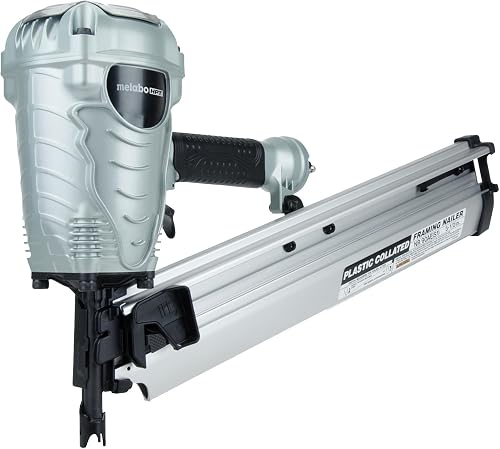
- 21-degree plastic collated nails
- 2 to 3-1/2 in nail length
- 7.5 lb tool weight
- Selective actuation
Choose this pneumatic nailer for regular framing and sheathing work when your fasteners use plastic collation. Selectable firing modes and tool-less depth control help you adapt to different fastening tasks.
Pros
- Switches between sequential and contact nailing
- Tool-less depth adjustment
- Head guard designed for easier maintenance access
- Metabo HPT Professional 5-Year Tool Warranty
Cons
- Needs a compatible compressor and hose
- Doesn't accept 30-degree paper collated nails
The depth dial helps when changing materials or moving between fastening tasks with different drive requirements. The firing-mode switch gives you a choice of operating methods, although full sequential operation is the safer default.
Metabo HPT also designed the head guard for easier disassembly during maintenance. That helps with service access, but it doesn't replace routine cleaning or the manual's care steps.
Who should buy the Metabo HPT NR90AES1?
Choose it if you regularly build with compatible framing nails and can keep a hose within reach. It makes particular sense when you already have an air setup that meets its requirements.
Skip it if most of your work involves trim, delicate moldings or small furniture parts. Those tasks need a different fastener size and tool category, as explained in what a framing nailer is used for.
It is also a poor match if every job starts far from your compressor. For scattered repairs, carrying air equipment between work areas can become a larger burden than the nailer itself.
Which nails and connections suit the NR90AES1?
The NR90AES1 accepts 2 to 3-1/2 in plastic collated framing nails at 21 degrees. Nail length is only one part of compatibility, so confirm the permitted diameter and head style in the tool manual before ordering fasteners.
Start with the project's fastening schedule or connector instructions. These determine the nail's required dimensions, type, spacing and placement.
A longer nail isn't automatically a better choice. Excess length can leave a sharp point through the far side, while the wrong diameter or head can fail to meet a connection's requirements.
For outdoor construction, choose a fastener coating or material suited to the exposure and any treated lumber involved. Compatibility with the nailer and suitability for the wood are separate checks.
Don't assume a framing nailer can install every metal connector. Joist hangers and similar hardware can call for specific fasteners and an approved installation method.
If your required fastener falls outside this tool's range, choose the right tool for that connection. The best framing nailers guide offers a wider starting point for comparing formats.
How do the firing modes and depth adjustment help?
Use full sequential firing for deliberate placement, then set drive depth to match the connection. Contact operation requires extra care because trigger and nose contact can lead to an unintended discharge.
Learn the manual's exact operating sequence before connecting the air supply. Never defeat the contact safety or carry the nailer with a finger on the trigger.
For depth setup, use secured scrap that matches the actual wood and material layers. Drive a few trial nails, inspect both sides and adjust until the heads sit as the job requires.
Overdriving can crush wood fibers or push a nail head too far through a panel face. Underdriving leaves a proud head that may interfere with the next layer.
Set compressor pressure within the manual's range and use the depth control for fine changes. Raising pressure beyond the allowed limit is not a fix for poor driving.
Wear eye and hearing protection, keep others clear and keep your free hand away from the nail path. Read how to use a nail gun safely before starting unfamiliar work.
Will your compressor and hose suit the job?
Your compressor must supply the required pressure and enough air volume for your fastening pace. Check both against the nailer's manual rather than judging compatibility by tank size alone.
An air tank stores a reserve, but the compressor must replenish it during repeated use. A setup that handles occasional shots may struggle when you fasten continuously.
Check the hose size, couplers and fittings against the tool's requirements. Leaks, restricted fittings and a poorly matched hose can reduce the air available at the nailer.
Plan a hose route that stays clear of sharp edges, ladders and walking paths. Leave enough slack for positioning without allowing loops to catch around your feet.
Account for the whole setup before buying: compressor, hose, fittings, suitable nails and protective equipment. If you want to avoid air equipment, read whether a nail gun can work without a compressor.
For jobs spread across several rooms or outdoor work areas, a cordless framing nailer may be easier to move. The useful comparison is how you reach each fastening point, not just how you power the tool.
How much do weight and access matter?
Weight matters most when you hold the tool away from your body or repeatedly change position. A small difference becomes more relevant during reaching and overhead work than during fastening at waist height.
Metabo HPT describes the NR90AES1 as well balanced. Your working position, hose routing and grip still shape how manageable the complete setup feels.
Look at access before committing to a magazine format. A nailer that fits an open wall section may be awkward near a corner, blocking or an existing structure.
Plan safe access that keeps the work within reach. Don't compensate for poor positioning by stretching from a ladder or forcing the tool into a connection at the wrong angle.
How does the NR90AES1 compare with the alternatives?
Choose the NR90AES1 for regular work using its nail format; choose an alternative for a specific need such as corner clearance, anti-dry-fire protection or tool-free jam access. All 4 options here require compressed air.
| Model | Nail format and length | Tool weight | Main reason to consider it |
|---|---|---|---|
| Metabo HPT NR90AES1 | 21-degree plastic, 2 to 3-1/2 in | 7.5 lb | Adjustable controls for varied framing work |
| Metabo HPT NR90ADS1 | 30-degree paper, 2 to 3-1/2 in | 7 lb | Magazine designed to help in tight corners |
| NuMax SFR2190 | 21-degree plastic full round head, 2 to 3-1/2 in | 8.6 lb | Anti-dry-fire mechanism |
| DOTOOL | 21-degree offset round head, 2 to 3-1/2 in | 8.9 lb | Tool-free jam release |
Matching magazine angles do not make nail strips interchangeable. Confirm the complete fastener requirements for the exact tool.
Metabo HPT NR90ADS1: choose it for corner access
The NR90ADS1 is the better match when you need paper collation or a magazine designed for tight corners. It accepts clipped and offset round head framing nails, subject to the project's fastener requirements.
It retains selectable sequential and contact operation, plus tool-less depth adjustment. You don't have to give up those controls to change magazine formats.
Skip it if your existing nail supply uses plastic collation and changing formats brings no benefit to your work. For the broader comparison, see the Metabo HPT NR90ADS1 among other framing nailers.
NuMax SFR2190: choose it for fencing and crate projects
The NuMax suits fencing, pallet and shipping crate assembly, along with framing and decking tasks. Its anti-dry-fire mechanism prevents empty firing, while the adjustable exhaust lets you direct air away from your face.
It accepts nail diameters from 0.113 to 0.131 in. A no-mar tip adds surface protection, though it doesn't make a framing nailer suitable for fine trim.
Choose it when these features match your work; skip it when lower tool weight is a leading concern. For outdoor projects, the guide to nail guns for fencing helps narrow the tool choice around the fence components.
DOTOOL: choose it for deliberate placement and jam access
The DOTOOL suits buyers who want sequential operation and tool-free jam release. Its open nose provides access for jam removal, and the rubber nose sleeve is designed to reduce slipping during toe-nailing.
It accepts nail diameters from 0.113 to 0.130 in and holds 60 nails. Direct the adjustable exhaust away from yourself before working.
Skip it if you need selectable contact firing or want the lightest option here. For angled fastening, follow the required nail position and connection details rather than relying on the nose sleeve to guide placement.
If mobility remains your main concern, compare cordless versus pneumatic nailers. The framing nailer guide explains the wider selection process.
How should you set up and care for the NR90AES1?
Follow the manual's connection and loading sequence, then check operation on matching scrap before fastening the project. Initial setup should confirm nail fit, air supply and drive depth.
Before use, inspect the hose, fittings, magazine and nose for damage or debris. Confirm that the trigger and contact safety move as the manual describes.
Use the lubrication type and schedule specified for the tool. Don't assume that another pneumatic nailer's oil routine applies, and don't add oil as a substitute for diagnosing a fault.
Disconnect the air supply before clearing jams, servicing the tool or making adjustments that require disconnection. Stored fasteners and trapped pressure deserve care even when the compressor is switched off.
Keep nail strips dry and free from damage. Bent strips, loose debris and the wrong fasteners can interfere with feeding.
After work, clean debris using the manual's method, unload as directed and store the nailer in a dry place. Drain the compressor according to its own instructions.
Metabo HPT backs the NR90AES1 with its Professional 5-Year Tool Warranty. Keep proof of purchase and follow the maintenance requirements and service terms.
Which common mistakes should you avoid?
The biggest mistake is choosing nails by length alone. Angle, collation, diameter, head style and the connection's requirements all matter.
Another mistake is blaming every proud nail on insufficient pressure. Check fastener compatibility, depth setting, hose condition and air recovery before changing the regulator.
Don't keep firing through an irregular feed or a jam. Disconnect the air and follow the clearing procedure instead of repeatedly pulling the trigger.
Avoid placing your free hand behind the fastening point. A nail can pass through thin material or exit in an unexpected direction.
Finally, don't use a no-mar tip as permission to overdrive nails. Surface protection and correct fastening depth solve different problems.
Should you choose the Metabo HPT NR90AES1?
Choose the Metabo HPT NR90AES1 if your required fasteners fit it, your air setup can support the work and you expect regular framing tasks. Before ordering, confirm the nail specification and compressor requirements together.
Pick the NR90ADS1 when corner access or paper collation drives the decision. Choose the NuMax for its anti-dry-fire feature and fencing or crate applications, or the DOTOOL when sequential placement and jam access are your priorities.
If moving the hose would slow down most of your jobs, compare cordless framing nailers before committing to an air-powered setup.
Frequently asked questions
What nails does the Metabo HPT NR90AES1 use?
The NR90AES1 accepts 21-degree plastic collated framing nails from 2 to 3-1/2 in long; match the nail diameter and head style to the tool manual as well. For structural work, also follow the required fastener schedule, since magazine compatibility doesn't make every nail suitable for every connection.
Can the NR90AES1 switch between sequential and contact nailing?
Yes, the NR90AES1 has a switch for choosing sequential or contact nailing; full sequential operation is the safer default for deliberate placement and reducing unintended discharge. Follow the manual's exact trigger sequence and mode-change procedure, and keep your finger off the trigger while moving or positioning the tool.
Does the Metabo HPT NR90AES1 need an air compressor?
Yes, the NR90AES1 is pneumatic and needs a compatible compressor, hose and fittings; compare the manual's operating pressure and air demand with your compressor's output before buying. A compressor's maximum pressure alone doesn't show whether it can keep up with repeated fastening at your planned pace.
How heavy is the NR90AES1?
The NR90AES1 weighs 7.5 lb before accounting for the attached hose; for buying purposes, consider the positions you'll work in and how often you'll move the tool. Hose drag and repeated reaching can affect comfort, so plan compressor placement and access rather than choosing by tool weight alone.


