8 Best Nail Guns for Baseboards and Trim (October 2026)
The best nail guns for baseboards and trim include the Metabo HPT NT65M2S 16 Ga Finish Nailer for mixed trim projects, the DeWalt DWFP12231 Pneumatic Brad Nailer Kit for shoe molding, and the Metabo HPT NT50AE2 Pneumatic Brad Nailer for long trim runs.
On this page (9 sections)
- How we chose these nail guns for baseboards
- Which nail gun for baseboards fits your project?
- Should you choose 15, 16 or 18 gauge for baseboards?
- How do you choose nail length for baseboards?
- What compressor setup do these baseboard nailers need?
- How do you set up a nailer for clean baseboard installation?
- Which mistakes cause loose trim and extra filling?
- How should you care for a pneumatic trim nailer?
- Which nail gun should you choose for baseboards?
The best nail gun for baseboards is the Metabo HPT NT65M2S for mixed trim projects, with a finish-nail size that suits substantial boards and other molding. Choose an 18 gauge brad nailer instead when your work centers on shoe molding or lighter trim.
Start with the board and wall assembly, then choose the tool. Tall baseboard isn't always thick or heavy, and a larger nail won't fix poor backing or a badly fitted joint.
All 8 picks use compressed air. If you already have a suitable compressor, focus on gauge, access and weight; if you don't, account for the full air setup before buying.
Our picks at a glance
-
1
 Best for mixed trim projects
Metabo HPT NT65M2S 16 Ga Finish Nailer
9.0/10 our score
See it on Amazon -
2
-
3

- 4
 Check it
Metabo HPT NT65MA4 15 Ga Angled Finish Nailer
Best for thick baseboards - 5
 Check it
Makita AF506 18 Ga Pneumatic Brad Nailer
Best for confined trim repairs - 6
 Check it
3PLUS HDA1564SP 15 Ga Angled Finish Nailer
Best for occasional heavy molding - 7
 Check it
Metabo HPT NT50A5 Pneumatic Brad Nailer
Best for frequent trim installers - 8
 Check it
NEU MASTER 18 Ga Pneumatic Brad Nailer
Best for first trim projects
How we chose these nail guns for baseboards
We compared fastener size, nail length, weight and placement features for baseboards, shoe molding and related trim. GracefulGate's scores reflect those features and each tool's fit for the job.
The top-ranked tool is the most useful middle ground for mixed projects. A lower-ranked brad nailer can still be the better choice for delicate molding, where a larger finish nail creates needless filling work.
Depth controls, nose protection and jam access matter because fitting and finishing take much of the work. Those features help you manage placement, but they don't replace correct fasteners or sound backing.
Which nail gun for baseboards fits your project?
Choose a finish nailer for substantial boards and a brad nailer for small molding or lighter baseboards. The individual picks below suit different workloads, from one room of shoe molding to repeated trim installation.
Top nail gun for baseboards: Metabo HPT NT65M2S
Metabo HPT NT65M2S 16 Ga Finish Nailer
- 16 gauge finish nails
- Accepts 1 to 2-1/2 in nails
- 3.7 lb
- Tool-free depth adjustment
The middle-ground choice for substantial baseboards, casing and chair rail when you want one finish nailer for several rooms.
Pros
- Nail range covers varied molding thicknesses
- Tool-free depth adjustment
- No-mar tip protects trim
Cons
- Larger holes than an 18 gauge brad nailer
- Requires a compressor and hose
The NT65M2S is the best starting point if your project includes baseboards, door casing and chair rail. Its 16 gauge nails from 1 to 2-1/2 in cover varied trim thicknesses without moving straight to the largest fastener here.
At 3.7 lb, it weighs less than either angled finish nailer in this group. That matters when you repeatedly lift the tool, position a board and move along a wall.
The tool-free depth control helps you adjust between materials, while the no-mar tip protects the contact point. An adjustable exhaust lets you direct discharged air away from your face and nearby work.
Choose sequential mode for deliberate placement along marked fastening points. The tool also offers bump fire, but speed adds little value when you're aligning a joint.
Skip this model if your work is mostly thin shoe molding. A brad nailer leaves smaller holes, and you won't gain useful holding strength from an oversized fastener in a delicate piece.
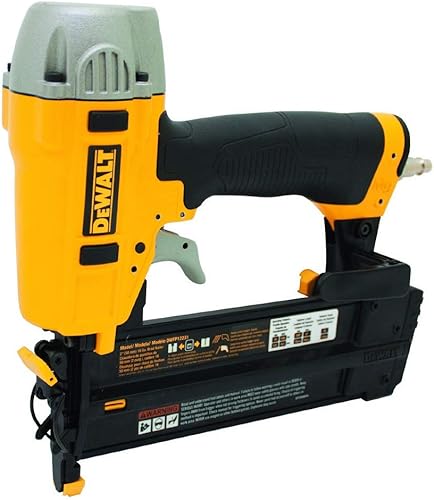
DeWalt DWFP12231 for shoe molding and small trim
DeWalt DWFP12231 Pneumatic Brad Nailer Kit
- 18 gauge brad nails
- Accepts 5/8 to 2 in nails
- Tool-free depth adjustment
- Sequential trigger
A focused choice for shoe molding and small trim, with a sequential trigger and tool-free access for clearing jams.
Pros
- Small brad holes simplify touch-up
- Tool-free depth adjustment and jam release
- Removable non-marring nose tip
Cons
- Not the first choice for heavy baseboards
- Requires a compressor and hose
The DWFP12231 suits buyers adding shoe molding after the main baseboards are already secure. Its 18 gauge brads from 5/8 to 2 in give you options for small trim while keeping the entry holes modest.
Its sequential-style trigger is useful for placing each fastener with care. The removable non-marring tip protects the surface, and the depth control lets you set the head just below it for filling.
A tool-free jam release simplifies access when a nail sticks. Disconnect the air and follow the manual before opening the nose, even when clearing it requires no extra tools.
DeWalt's maintenance-free motor is a useful distinction for buyers who want to avoid routine motor oiling. Follow its care instructions rather than applying another pneumatic tool's oil routine.
Skip it for heavy baseboards that call for finish nails. It makes more sense as a small-trim tool or as a companion to a finish nailer than as the only nailer for substantial molding.
Metabo HPT NT50AE2 for long runs of light molding
Metabo HPT NT50AE2 Pneumatic Brad Nailer
- 18 gauge brad nails
- Accepts 5/8 to 2 in nails
- 2.2 lb
- Selective actuation
The lightest tool here suits long runs of light molding where frequent lifting and repositioning make weight matter.
Pros
- Lowest tool weight in this group
- Magazine reload indicator
- Sequential or bump-fire selection
Cons
- Brads offer less holding strength than finish nails
- Requires a compressor and hose
The NT50AE2 is the pick for buyers who put low tool weight first. At 2.2 lb, it's the lightest nailer here, which helps when you spend a room repeatedly lifting, aiming and repositioning.
It accepts the same brad-length range as the DeWalt. The practical difference is its combination of low weight, selectable firing modes and a magazine indicator that shows when nails are running low.
Use sequential mode when fastening to marked backing or working near joints. The depth dial gives you a way to adjust the head position as you move between softer and harder trim.
Its no-mar tip and adjustable exhaust help you manage contact marks and discharged air around finished work. The easy-to-clear nose provides access if a nail jams.
Choose it for light baseboards and long shoe-molding runs where brads provide adequate hold. Skip it if you need to draw substantial trim firmly against framing, since low weight doesn't change the limits of a thin fastener.
Metabo HPT NT65MA4 for substantial base molding
Metabo HPT NT65MA4 15 Ga Angled Finish Nailer
- 15 gauge angled DA nails
- Accepts 1-1/4 to 2-1/2 in nails
- Angled magazine
- Integrated air duster
Choose this angled finish nailer for substantial base molding and corner work where a thicker fastener is appropriate.
Pros
- Angled magazine improves corner access
- Tool-less depth adjustment
- Adjustable exhaust and air duster
Cons
- Larger holes need more filling
- Excessive fastener size for delicate trim
The NT65MA4 is the better match for thick baseboards and substantial casing that call for a larger finish nail. It uses 15 gauge angled DA nails from 1-1/4 to 2-1/2 in, so buy that exact fastener format.
Its angled magazine helps you approach corners without the magazine taking up as much space behind the nose. You still need room to place the contact tip squarely and keep the nail path safe.
The tool weighs 4.2 lb and includes a depth adjuster, air duster and rotating exhaust. Those features suit room-by-room finish work where material and working position change.
Choose it if your next projects also include larger door trim or crown molding. Metabo HPT includes base molding among its intended uses, making it a focused choice for substantial trim work.
Skip it for delicate shoe molding or tiny returns. The thicker fastener leaves a larger hole and can be a poor match near narrow edges, even with careful depth adjustment.
Makita AF506 for small trim in confined spaces
Makita AF506 18 Ga Pneumatic Brad Nailer
- 18 gauge brad nails
- Accepts 5/8 to 2 in nails
- Narrow nose
- Tool-less depth adjustment
The narrow nose suits small molding repairs beside door casing and other places with limited room for placement.
Pros
- Narrow nose reaches confined areas
- Built-in air duster
- Non-marring rubber nose
Cons
- Brads are unsuitable for some heavy molding
- Requires a compressor and hose
The AF506 suits small-trim repairs beside casing and other spots where room around the contact point is limited. Its narrow nose helps with access, while the non-marring rubber contact surface protects the trim.
This brad nailer weighs 2.86 lb and accepts the same fastener-length range as the other brad tools here. Choose it for nose access rather than expecting more holding strength from its shape.
The aluminum body, magazine and cylinder are useful construction details. A depth dial controls the nail-head position, and the built-in air duster can clear loose debris from the work area.
Makita specifies a 70 to 120 PSI operating range. Use the manual's setup guidance and adjust on scrap rather than assuming the upper limit is the right starting point.
Skip this model if your main task is heavy baseboard installation. A narrow nose can solve an access problem, but it cannot make brads perform like larger finish nails.
3PLUS HDA1564SP for occasional heavy-molding jobs
3PLUS HDA1564SP 15 Ga Angled Finish Nailer
- 15 gauge angled DA nails
- Accepts 1-1/4 to 2-1/2 in nails
- Tool-free depth adjustment
- Quick-clear jam release
An angled finish nailer for short projects involving substantial molding, if carrying the heaviest tool here is acceptable.
Pros
- Angled format suits awkward approaches
- Quick-clear jam release
- No-mar tip and adjustable exhaust
Cons
- Highest tool weight in this group
- Trigger changes use interchangeable parts
The HDA1564SP suits a short project involving substantial trim when you want an angled finish nailer and can accept extra weight. At 5.51 lb, it's the heaviest tool in this group.
It uses the same DA-style fastener range as the NT65MA4. That makes fastener compatibility a straightforward comparison, while weight becomes a stronger reason to choose between them.
The 3PLUS includes tool-free depth adjustment, a no-mar tip and a quick-clear jam release. Its rotating exhaust gives you control over where discharged air goes as you change working position.
Single-shot and bump-fire operation use interchangeable triggers. Read the manual before changing them, and disconnect the air supply before working on the trigger assembly.
Choose it for occasional substantial molding where the tool won't spend hours in your hand. Skip it for extended trim runs if weight is a concern, or for a mixed project dominated by small decorative pieces.
Metabo HPT NT50A5 for frequent small-trim work
Metabo HPT NT50A5 Pneumatic Brad Nailer
- 18 gauge brad nails
- Accepts 5/8 to 2 in nails
- 2.9 lb
- Aluminum magazine
A brad nailer for repeated light trim jobs, with a narrow nose, reload indicator and a belt hook that mounts on either side.
Pros
- Narrow nose and short center height
- Ambidextrous belt hook
- Aluminum magazine and reload indicator
Cons
- Heavier than the NT50AE2
- Does not replace a finish nailer for substantial boards
The NT50A5 suits frequent trim installers who want placement and carrying features beyond a basic brad nailer. Its narrow nose and short center height help with access near corners and other obstructions.
The belt hook can mount on either side, which is useful when your preferred carrying position changes with the room layout. A reload indicator helps you check nail supply before starting another section.
At 2.9 lb, it's heavier than the NT50AE2. Choose it for its hook, aluminum magazine, integrated air duster and nose design rather than for minimum weight.
It accepts the common brad-length range used by the other 18 gauge picks. The depth dial and selectable firing modes let you adapt the setup while keeping the same fastener type.
Skip it if you only need a tool for one short run and won't use those handling features. It also won't replace a finish nailer when the main baseboard requires larger fasteners.
NEU MASTER for a first light-trim project
NEU MASTER 18 Ga Pneumatic Brad Nailer
- 18 gauge brad nails
- Accepts 5/8 to 2 in nails
- 800 brad nails included
- Tool-free depth adjustment
A starter kit for light trim projects that includes nails and accessories, but still needs a separate compressor and hose.
Pros
- Includes 800 nails in two lengths
- Case, safety glasses and oil included
- Tool-free jam-clear nose
Cons
- Heavier than the other brad nailers here
- Included nail lengths may not suit your wall assembly
The NEU MASTER kit suits a first light-trim project if you already have access to suitable air equipment. It includes 800 brads, split between 1-1/4 and 2 in lengths, plus a case, glasses, oil and 2 Allen wrenches.
Those accessories reduce the number of separate items to gather. Choose nail length from your wall and trim measurements, though, rather than using whichever included strip is closest at hand.
The tool accepts brads from 5/8 to 2 in and offers tool-free depth adjustment and jam access. Its stated operating range is 60 to 120 PSI.
At 4.4 lb, it's heavier than every other brad nailer here. That is a meaningful drawback for long runs, especially if low tool weight is your main reason for choosing pneumatic equipment.
Skip it if you need a complete compressor package or a tool for heavy molding. The included work contact element requires nose contact before firing, but safe handling still depends on your actions.
Should you choose 15, 16 or 18 gauge for baseboards?
Choose 16 gauge for mixed substantial trim, 15 gauge for heavier molding and 18 gauge for lighter pieces. A lower gauge number means a thicker nail, so the trade-off is holding strength against hole size and splitting risk.
Board height alone doesn't settle the choice. A tall, thin profile can need a different approach from a thick hardwood board of the same height.
Match the fastener to the whole installation
Consider trim thickness, material, backing and how well the board fits the wall. A piece that sits naturally in place is easier to secure than one that needs force to close a large gap.
Don't keep adding brads to make up for an unsuitable fastener. Check the fit and backing first, then use the trim maker's fastening guidance to choose the nail size.
Read whether a brad nailer can handle baseboards if you're deciding whether an existing tool is enough. Our brad nailer vs finish nailer comparison explains the wider trade-offs.
Decide whether one tool covers the job
A finish nailer can handle the main baseboard while a brad nailer secures smaller shoe molding. Buying one tool for both tasks can leave you compromising on either holding strength or hole size.
For several rooms of substantial trim, browse the best finish nailers. If your future projects vary more widely, use our guide to what gauge nailer you need.
How do you choose nail length for baseboards?
Choose a nail that passes through the trim and wall covering and reaches suitable framing with the penetration required for the installation. Use measured layers, rather than a single nail length for every room.
Start with the board thickness at the fastening point. A shaped profile may be thick near its lower edge and much thinner near the top.
Account for drywall, plaster or other wall layers between the trim and framing. Extra layers reduce how much of the nail reaches solid backing.
Locate suitable fastening points and check for concealed wiring or pipes before driving. A stud mark alone doesn't prove that the entire nail path is clear.
Don't choose the longest accepted nail as a default. Extra length can add risk without improving an installation that already has adequate penetration.
Keep gauge, length and collation together when buying fasteners. In particular, the angled finish nailers here require DA-style nails, not any angled nail strip that happens to have the same gauge.
What compressor setup do these baseboard nailers need?
Every pick needs a compatible compressor, hose and fittings, with pressure and air delivery that meet its manual. A carrying case and nail assortment don't make a pneumatic kit self-contained.
Check air delivery as well as maximum pressure when choosing a compressor. The system needs to supply the tool at your working pace, rather than simply reach a pressure shown on the tank gauge.
Plan where the compressor will sit and how the hose will reach each wall. Keep the hose clear of your feet, fresh paint and finished flooring, and avoid pulling it tight around doorways.
Follow the tool's connection and loading sequence. Use the regulator and depth control as directed, and don't exceed the nailer's operating range to compensate for a poor setup.
For a few scattered repairs, carrying air equipment may be less convenient than using battery power. Our cordless vs pneumatic nailer comparison helps you weigh that choice before committing to a compressor.
How do you set up a nailer for clean baseboard installation?
Begin with fitted trim, marked backing and a scrap piece of the same material. Nail depth comes after fit, because fasteners should secure the board rather than force a badly cut joint into place.
Prepare the board and fastening points
Dry-fit each piece and check its joints before loading the tool. Mark the framing locations in a way you can still see after the baseboard is positioned.
Support long boards so they don't shift while you work. Keep your free hand well away from both the entry point and any place a deflected nail could emerge.
Wear eye protection and hearing protection suited to the work. Follow the manual's handling instructions, and never bypass the work contact mechanism.
Adjust depth on scrap first
Use matching scrap with backing that represents the installation. Begin within the manual's recommended setup and adjust until the head sits just below the surface without crushing the surrounding material.
A proud head can mean insufficient pressure, an incorrect depth setting or an unsuitable fastener. Check those causes rather than increasing pressure without a plan.
An overdriven head leaves a larger repair and can reduce the material held under it. Recheck the setting when changing trim material or moving to a thinner part of the profile.
Place each fastener deliberately
Use sequential operation for controlled placement where the tool offers it. Keep your finger off the trigger while moving, and seat the nose securely before firing.
For shoe molding over a floating floor, fasten into the baseboard rather than pinning the floor in place. Follow the flooring maker's expansion guidance so the finished trim doesn't restrict movement.
Our guide to using a brad nailer covers the basic workflow for the lighter tools in this roundup.
Which mistakes cause loose trim and extra filling?
The most common avoidable mistakes are missing backing, using the wrong fastener and overdriving the head. Correct the cause before adding more nails or covering the area with filler.
- Nailing only into wall covering: Locate sound backing instead of relying on drywall or plaster to hold the board.
- Forcing a badly fitted piece: Recut, scribe or address the fit before trying to pull a large gap closed with fasteners.
- Working too close to an end: Thin trim and short returns can split or deflect a nail, so plan placement and follow the trim maker's guidance.
- Tilting the tool to squeeze into a corner: Reposition until the nose seats securely and you can control the nail path.
- Driving another nail beside a jam: Stop, disconnect the air and clear the tool according to its manual.
- Using caulk as a structural repair: Fill nail holes and suitable finish gaps only after the board is secure.
Inspect a newly fastened section before moving on. Catching a proud head, loose board or damaged edge early avoids repeating the same problem around the room.
How should you care for a pneumatic trim nailer?
Keep the magazine, nose and contact tip clean, and follow the oiling instructions for that exact model. Pneumatic tools don't all share the same lubrication routine.
Disconnect the air before clearing jams, opening service areas or doing maintenance. Follow the manual's unloading steps and keep the tool pointed away from people throughout the process.
Store nail strips dry and discard bent or damaged strips. Check that they seat correctly in the magazine rather than forcing a strip that doesn't fit.
Inspect the no-mar tip for damage or trapped debris. A protective tip can still mark trim if grit is pressed between it and the surface.
Check the hose and fittings for wear or leaks, and drain the compressor according to its instructions. After work, clean away loose dust and store the nailer safely, disconnected from air.
Which nail gun should you choose for baseboards?
Choose the NT65M2S as your nail gun for baseboards when substantial boards, casing and chair rail share the project. Move to the NT65MA4 when larger finish nails and angled access fit the work.
For shoe molding, choose the DeWalt DWFP12231 for its sequential trigger and simple jam access. Pick the NT50AE2 if carrying the lightest tool matters more, or the Makita AF506 when confined placement is the main concern.
Before ordering, write down the trim thickness, wall layers, required fastener and compressor needs. That short checklist will tell you more than choosing by brand alone.
Use our complete nail gun guide to plan tools for other projects. Before starting this one, review the manual alongside our nail gun safety guide.
Our top 3 picks at a glance
-
1
Best for mixed trim projects
Metabo HPT NT65M2S 16 Ga Finish Nailer
9.0/10 our score
See it on Amazon -
2
-
3
Frequently asked questions
What gauge nail gun is best for baseboards?
A 16 gauge finish nailer is a practical choice for mixed baseboard work, while a 15 gauge tool suits substantial molding; use an 18 gauge brad nailer for lighter boards and shoe molding. Choose the fastener around the trim material, backing and required hold, rather than board height alone.
Can you use an 18 gauge nailer for baseboards?
Yes, an 18 gauge brad nailer can secure lighter baseboards when the trim maker permits it and the nails reach suitable backing; its small holes make filling easier. For heavy boards or trim that needs a firmer hold, choose a finish nailer instead of adding more brads.
How long should nails be for baseboards?
Choose nails that pass through the trim and wall covering with enough penetration into framing to meet the trim maker's guidance; measure those layers before choosing a length. Stay within the nailer's range, check for concealed services and avoid using longer nails simply because the tool accepts them.
Do pneumatic nail guns need an air compressor?
Yes, every pneumatic nailer here needs a separate air compressor and hose; match the compressor's pressure, air delivery and fittings to the tool manual before connecting it. If carrying that equipment is impractical, compare the alternatives in our guide to using a nail gun without an air compressor.
Should I use brad nails or finish nails for trim?
Use brads for small trim where a thinner fastener provides enough hold, and finish nails for more substantial molding; smaller holes are useful only if the board stays secure. Our brad nailer vs finish nailer guide explains how holding strength, splitting risk and finish work affect that choice.


